

Fast Steering Mirrors
Fast steering mirrors (FSMs), also known as tip-tilt mirrors, are used to rapidly and precisely control the direction of an optical beam in applications such as free-space optical communication, semiconductor manufacturing and microscopy. These systems require high control bandwidth, low settling times and exceptional pointing stability to maintain accurate beam positioning.
An FSM uses actuators to rapidly tilt a mirror, changing the direction of the reflected beam. The actuator, mirror and mechanical structure must work together to achieve the required tip-tilt range, bandwidth, pointing precision and thermal stability.
Reluctance actuators can unlock performance benefits for FSMs, combining a wide control bandwidth with a large tip-tilt range and low heat generation.
Tip-Tilt Actuators for Fast Steering Mirrors
Both piezoelectric and voice coil actuators are widely used in tip-tilt movement in fast steering mirror systems, each offering different performance characteristics.
Piezo actuators offer high stiffness, fast response and exceptional angular resolution. However, their limited displacement restricts the achievable tip-tilt range. Larger steering angles often require amplified mechanisms, adding complexity and compromising stiffness and bandwidth. Shock sensitivity, drift and high voltage requirements are also concerns in some applications.
Voice coil actuators provide smooth force output, relatively large travel and predictable dynamic response. However, their relatively low motor constant and force density limit the force that can be generated from a compact tip-tilt actuator, restricting dynamic performance at higher bandwidths. Generating higher forces also requires more electrical power, resulting in greater heat generation.
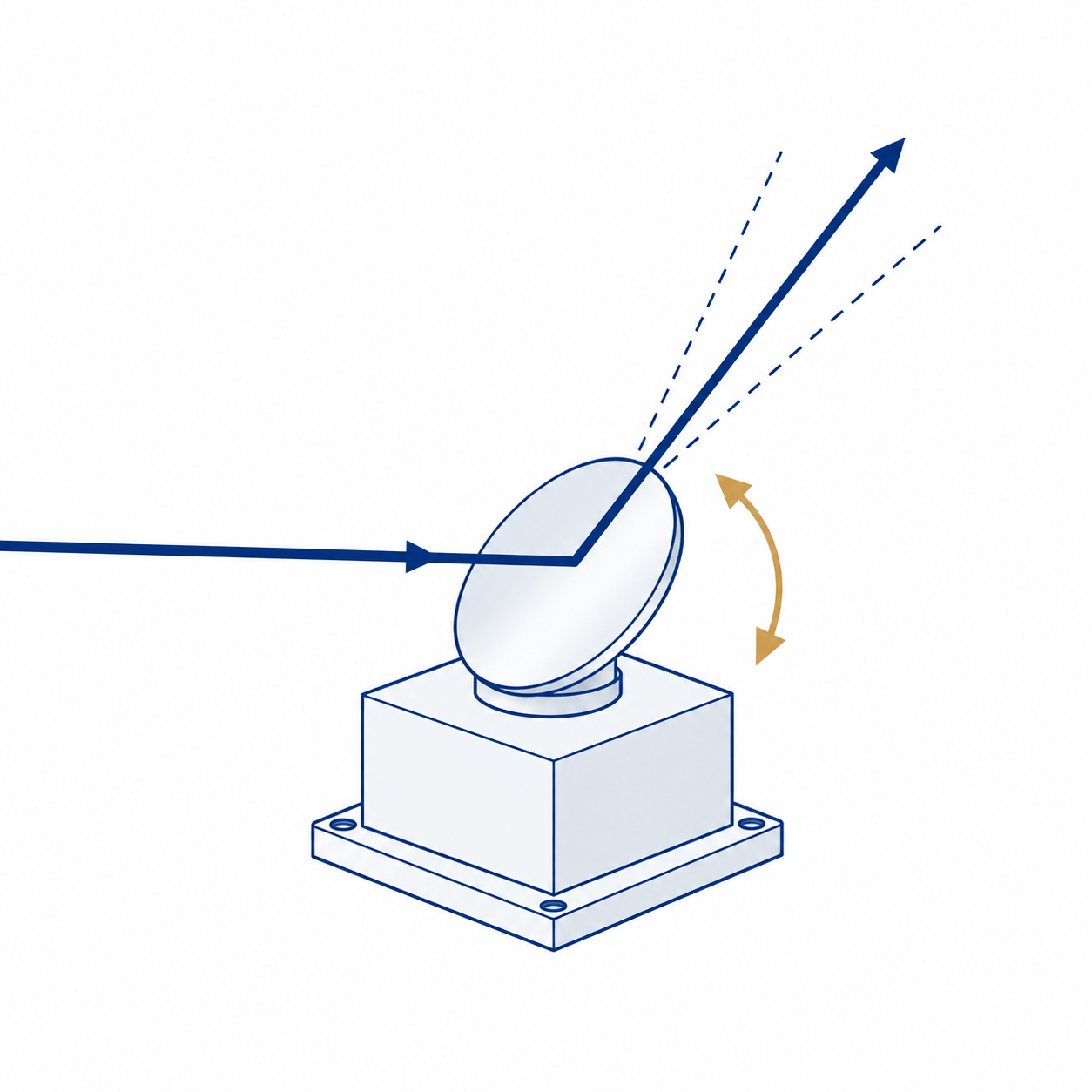
Fast Steering Mirror
These trade-offs create a fundamental challenge for FSM designers: achieving both large tip-tilt range and high control bandwidth while maintaining pointing precision and thermal stability.
This creates an opportunity for a third type of FSM actuator: the reluctance actuator. Reluctance actuators combine large travel, high dynamic performance and low electrical power requirements, offering a different balance of tip-tilt range, control bandwidth and thermal performance.
Reluctance Actuators for Fast Steering Mirrors
Reluctance actuators can expand the performance envelope of fast steering mirrors. The main advantages include:
Wide bandwidth
Reluctance actuators combine large travel with high dynamic performance, enabling a better trade-off between tip-tilt range and control bandwidth than conventional tip-tilt actuator technologies. This allows FSMs to achieve higher control bandwidth at a given tip-tilt range, or larger tip-tilt range at a given control bandwidth.
Research has shown that reluctance actuation can outperform established piezoelectric and Lorentz-force technologies across a significant part of the FSM performance space, particularly at bandwidths above 700 Hz and angular ranges below 120 mrad. Fluxthor's newer reluctance actuator technology is now pushing this performance further.
This is particularly valuable in applications where fast beam steering is critical. For example, in free-space optical communication, higher control bandwidth enables higher data rates, and therefore faster (internet) communication.
Large tip-tilt range
The 1–7° tip-tilt range represents an attractive performance region for fast steering mirrors, offering a strong balance between angular range and control bandwidth. Reluctance actuators offer larger angular range than piezo tip-tilt actuators, and can sustain these larger travel ranges at higher frequencies than voice coil actuators. This gives them the potential to outperform both piezo and voice coil technologies in this performance range.
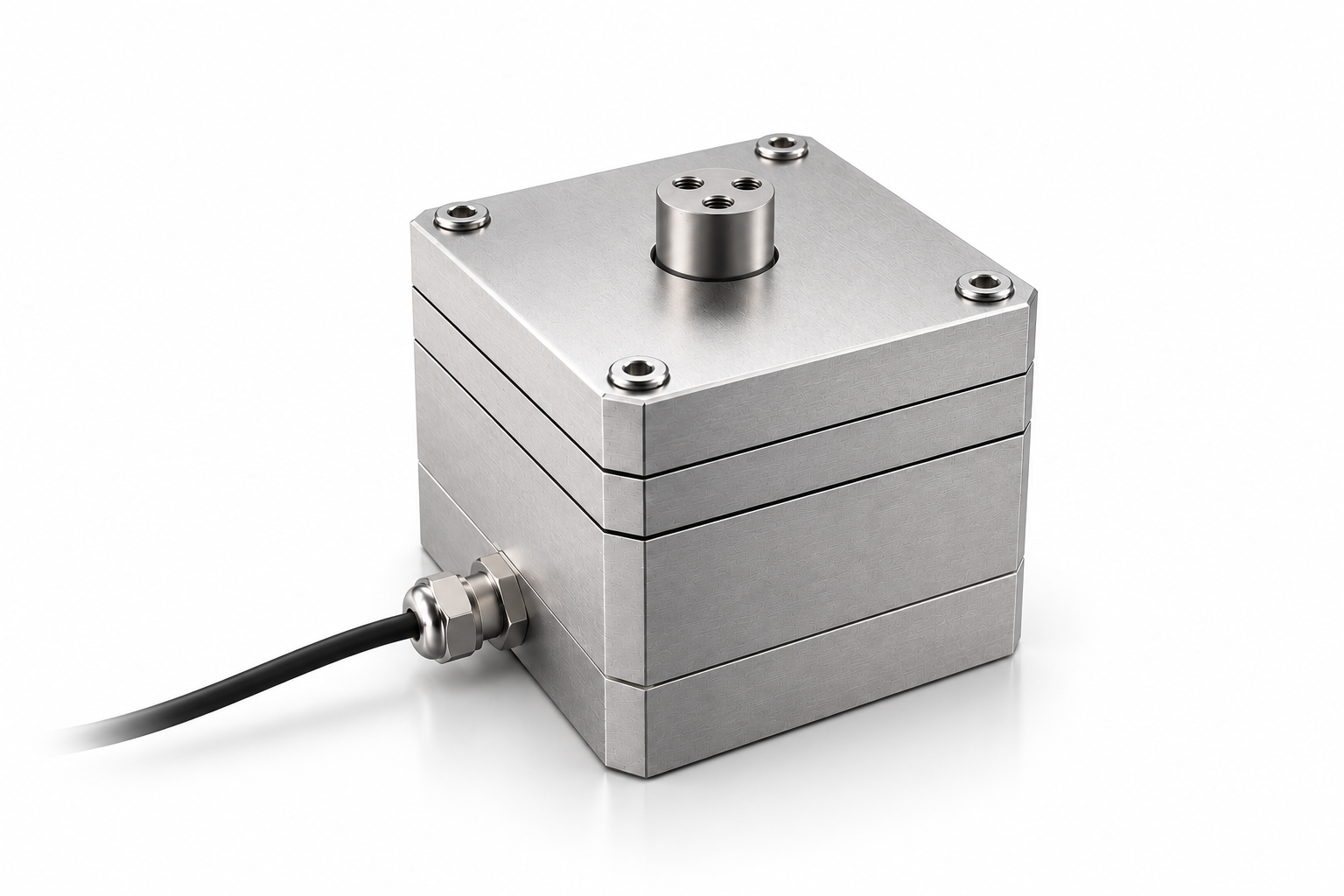
Low heat generation
Reluctance actuators can generate the required force with relatively low electrical power, reducing heat generation close to the mirror. This helps minimize thermally induced distortion and angular drift, supporting stable and precise beam steering during continuous operation.
For FSMs, thermal performance also depends on the mirror and optical coating. Minimizing optical absorption is therefore important alongside minimizing actuator heat generation.
High force density
Reluctance actuators have a motor constant 5× higher than voice coil actuators, enabling high dynamic force from a compact actuator with low electrical power requirements. This allows the actuator to be integrated close to the mirror while keeping the overall FSM compact.
High angular resolution
Reluctance actuators provide precise control of actuator position and force, with actuator positioning down to the sub-nanometer range. Combined with suitable mechanical design and position sensing, this enables very high angular resolution for precise and repeatable tip-tilt control in fast steering mirrors.
Conclusion
Reluctance actuators can expand the Pareto front of fast steering mirror performance by combining large tip-tilt range, high control bandwidth and low electrical power requirements. This enables greater steering authority and fast, precise beam control while reducing thermal effects that can compromise optical stability.
Fluxthor reluctance actuators therefore offer a compelling alternative to conventional piezoelectric and voice coil actuators for demanding optical applications.
About Fluxthor
Fluxthor is the world's first provider of commercial reluctance actuators, with extensive experience in developing high-performance actuation solutions for precision optical systems.
Contact Us
We will get in touch shortly to discuss possibilities and find a suitable solution for your application.