

Overcoming Voice Coil Actuator Limitations with Reluctance Actuators
Voice coil actuators (VCAs) are widely used in precision motion systems because they provide smooth, predictable, and direct force generation. However, the linear relationship between input current and output force inherent to Lorentz-force actuation creates important limitations in demanding high-precision applications. Generating higher forces requires either significantly higher currents or larger coil assemblies, resulting in increased heat dissipation, larger actuator sizes, lower force density, and reduced mechanical bandwidth and efficiency.
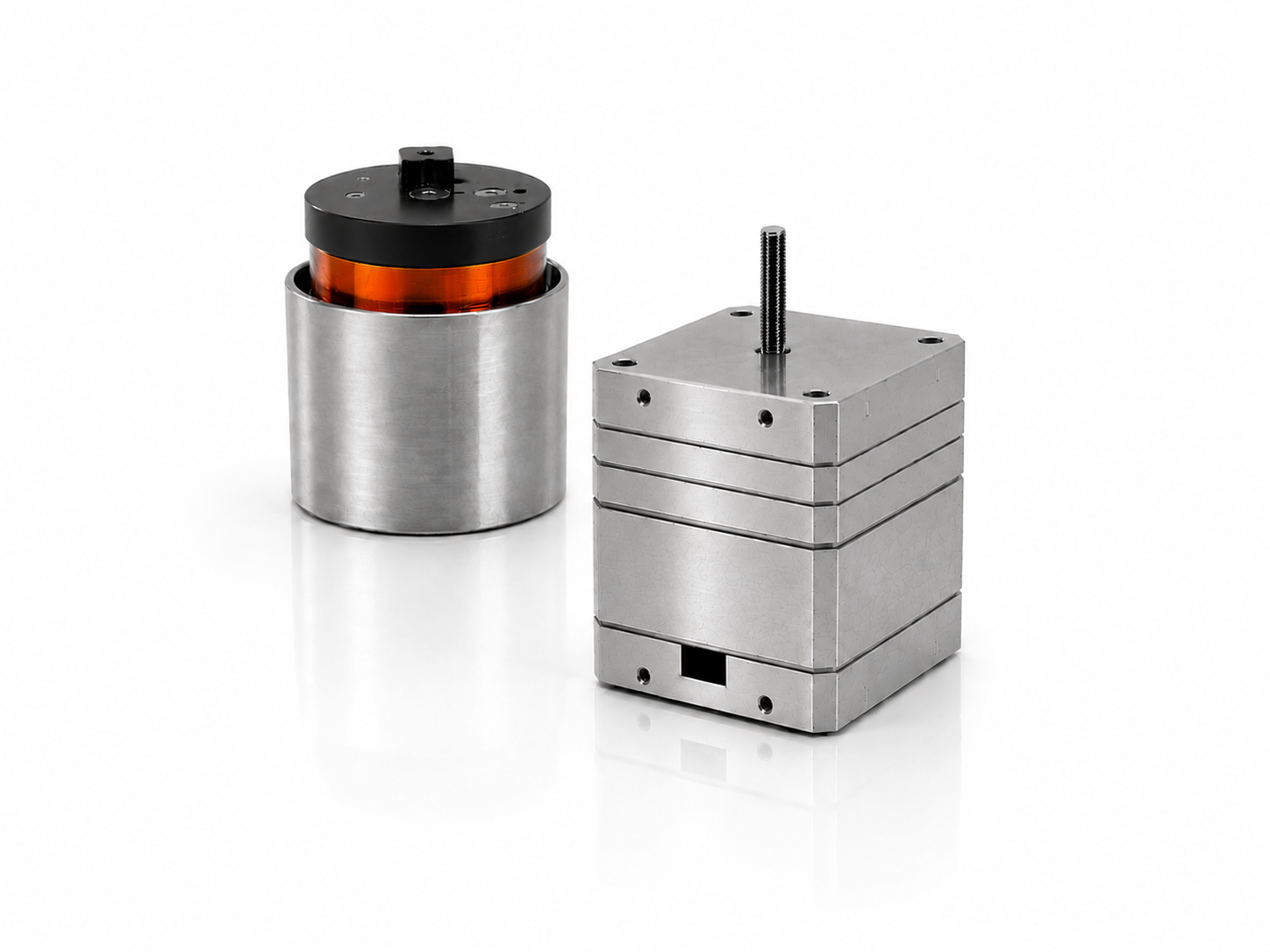
Unlike voice coil actuators, Fluxthor’s reluctance actuators generate force through magnetic reluctance rather than the linear Lorentz-force principle. Their nonlinear magnetic force generation enables significantly higher force density with lower current levels, reducing heat generation while improving compactness and dynamic performance. While this nonlinear behavior historically made reluctance actuators difficult to control in high-precision applications, Fluxthor has solved these challenges through advanced control methods.
Compared to traditional voice coil actuators, Fluxthor reluctance actuators achieve shorter travel ranges and less linear force characteristics, but:
Significantly lower heat dissipation
Up to 5× higher force density
Mechanical bandwidths up to 1-2 kHz
Much higher efficiency in static holding applications
Reduced magnetic stray fields
Lower dependence on rare-earth materials
Scalable across force ranges from mN to kN
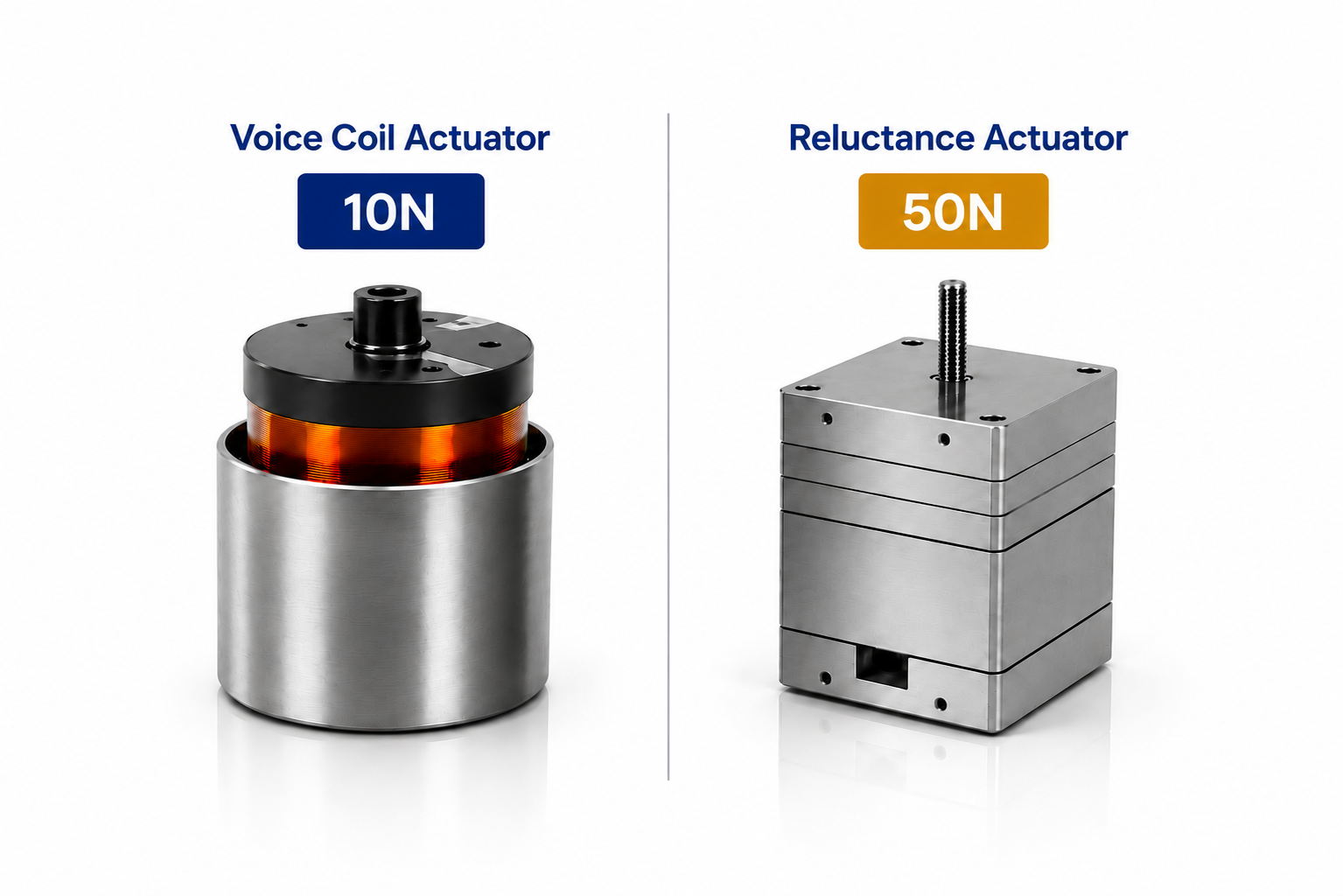
This makes reluctance actuators a highly attractive alternative for voice coil actuators in next-generation semiconductor, optical, nanopositioning, and vibration isolation systems where thermal stability, compactness, precision, and throughput are critical.
Voice Coil Actuators in High-Precision Applications
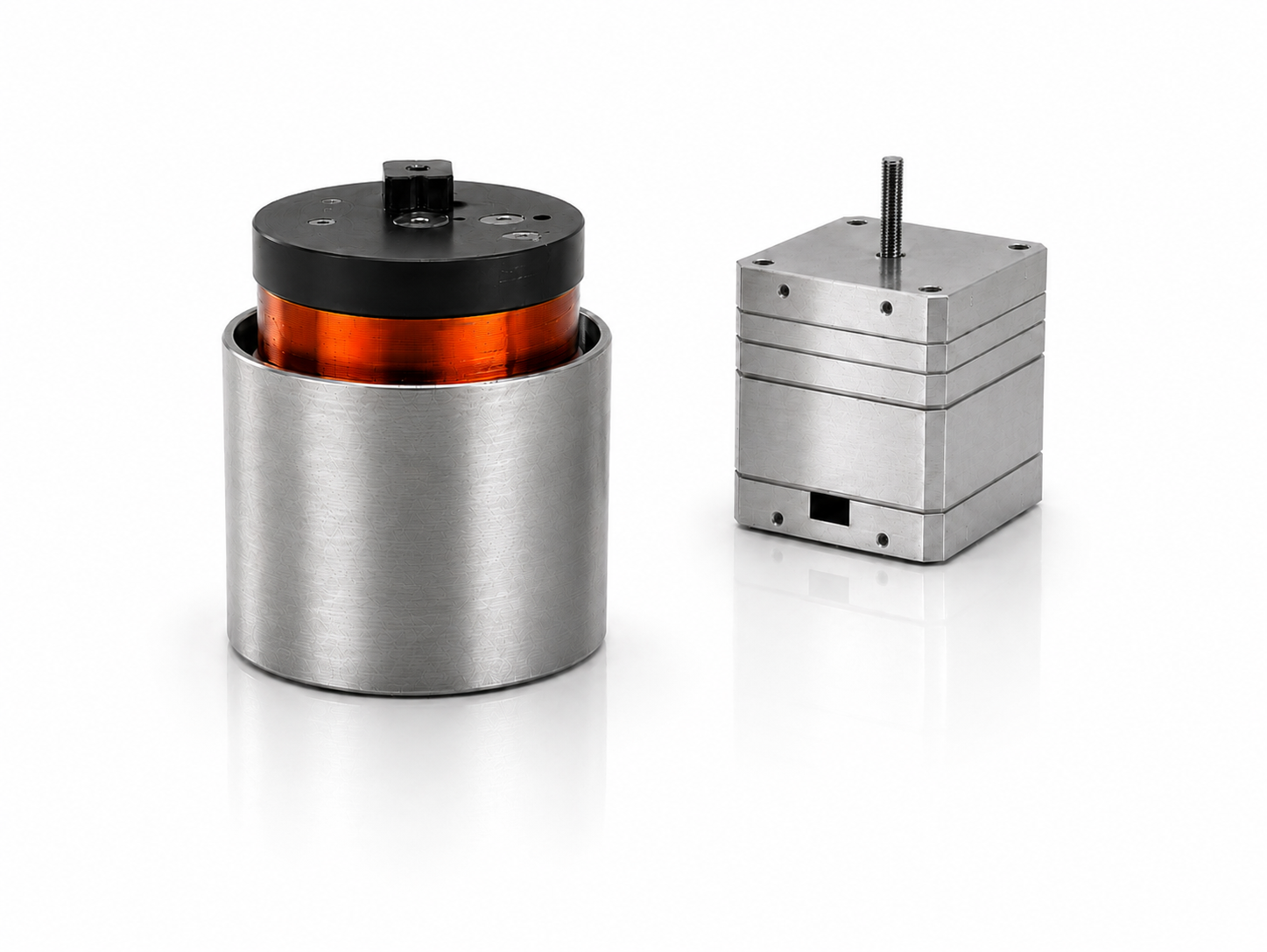
Voice coil actuators (VCAs) are electromagnetic actuators that generate force through the interaction between a magnetic field and a currentcarrying coil, based on the Lorentz effect. This enables smooth, direct-drive linear motion with very low friction, no mechanical transmission, and highly linear force characteristics over relatively large travel ranges.
Due to their excellent controllability, fast response, smooth force characteristics, and favorable high-frequency response, VCAs and other Lorentz-style actuators have become standard actuation technologies in high-tech motion systems.
They have been widely used for decades alongside piezo actuators and linear motors in applications such as semiconductor equipment, optical systems, precision positioning stages, and vibration isolation platforms.
Fast and Smooth
However, the Lorentz-force operating principle of VCAs creates an inherent linear relationship between input current and output force:
F ∝ I
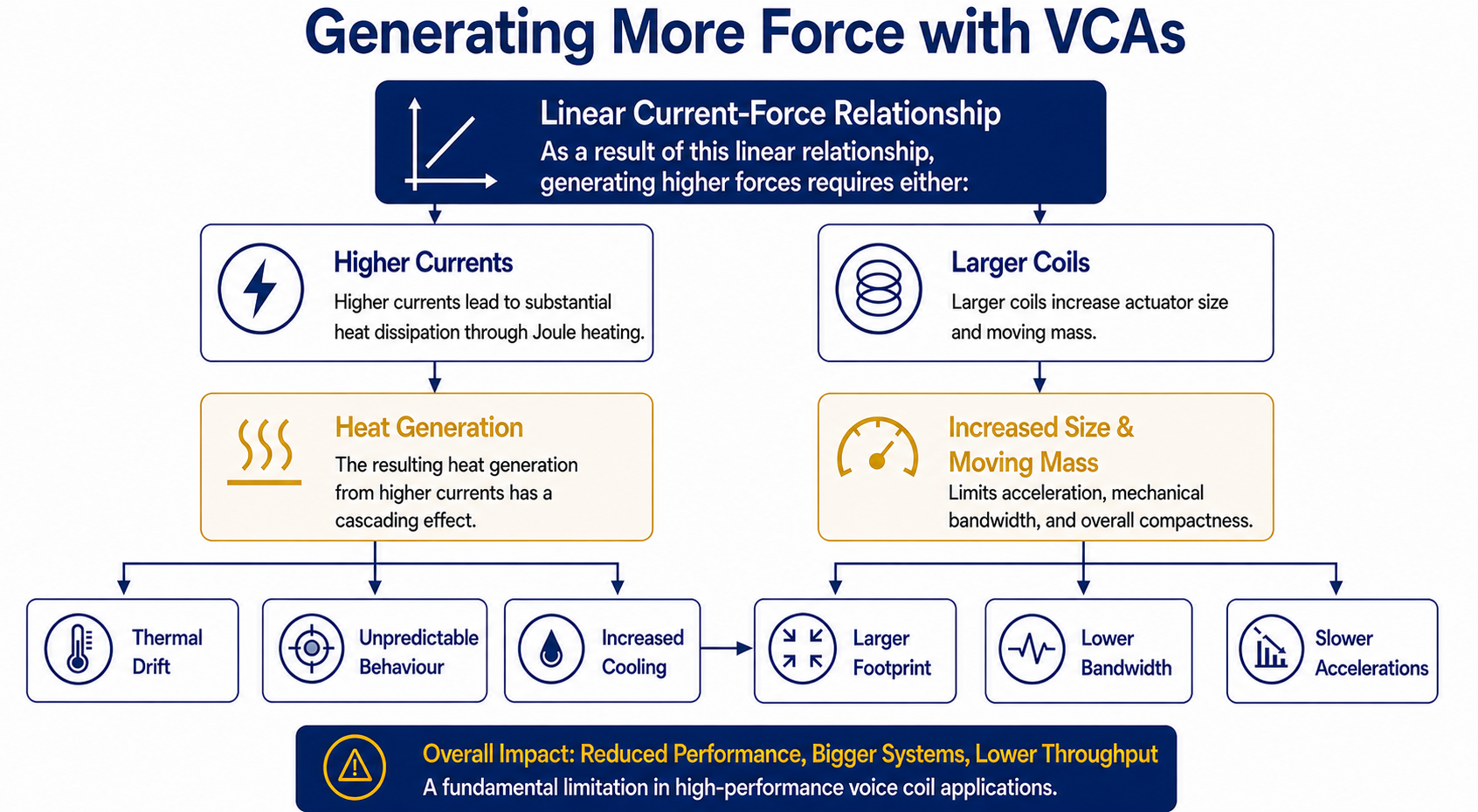
As a result of this linear relationship, generating higher forces requires either significantly higher currents or larger coil assemblies. Higher currents lead to substantial heat dissipation through Joule heating, while larger coils increase actuator size and moving mass, limiting acceleration, mechanical bandwidth, and overall system compactness, especially in high-force voice coil applications.
The resulting heat generation from higher currents has a cascading effect and can introduce unwanted thermal drift, reduce positioning stability and bandwidth, increase cooling requirements, and therefore negatively affect system compactness and throughput as well.
As performance demands for tomorrow’s technologies continue to increase, engineers are increasingly forced to trade precision for speed, bandwidth for thermal stability, or performance for compactness, revealing the practical limits of conventional voice coil actuator technology.
Linear Current-Force Scaling: A Double-Edged Sword
Thermal Challenges in High-Performance Voice Coil Actuators
Because of the linear relationship between current and force in voice coil actuators, high-performance applications often require elevated current levels. As a result, heat generation becomes unavoidable, especially in high-precision and high-bandwidth systems. While the electrical losses themselves reduce efficiency, the secondary effects of this heat often create much larger system-level challenges.
In ultra-precision systems operating at nanometer or picometer accuracy levels, even millikelvin-scale temperature fluctuations can introduce measurable positioning errors. As a result, achieving extreme precision with electromagnetic actuators often requires expensive active cooling systems and carefully controlled thermally stable environments.
To prevent thermal drift and protect sensitive components, engineers frequently need to implement additional thermal management strategies such as:
Active air or liquid cooling systems
Large heat sinks
Thermal isolation structures
Increased spacing between actuators and sensitive optics or sensors
Lower duty cycles
Reduced actuator force output
Oversizing of actuators to increase thermal capacity
Heat Dissipation in Voice Coil Actuators
Although these measures can reduce thermal effects, they also introduce significant disadvantages, including:
Increased system size and mass
Lower resonance frequencies and bandwidth
Added mechanical complexity
Higher power consumption
Increased cost and maintenance
Reduced reliability
Additional vibration sources from cooling systems
Downtimes when cooling liquids leak
As performance requirements continue to increase, thermal management itself increasingly becomes a limiting factor in the overall system architecture. In many high-end precision systems, a substantial portion of the engineering effort is dedicated not to improving performance, but to mitigating the unwanted thermal effects introduced by the actuator itself.
The Thermal Management Waterfall
Heat Dissipation in Vacuum and Cryogenic Systems
In high-tech manufacturing and metrology, OEMs are increasingly moving their processes into vacuum and cryogenic environments to push performance boundaries. These environments can significantly improve measurement stability, reduce contamination and air disturbances, minimize thermal noise, and enable higher precision and sensitivity.
Inside these environments, however, heat dissipation becomes at least an order of magnitude more difficult. Convection vanishes in vacuum, and every milliwatt matters at cryogenic temperatures. This creates major challenges for voice coil actuators, which dissipate significant amounts of heat through energized coils during operation.
As a result, industries such as EUV lithography, quantum computing, space-based instrumentation, and next-generation electron microscopy are increasingly reaching the practical thermal limits of conventional electromagnetic actuators.
Force Density and Compactness Constraints in Precision Systems
Beyond thermal challenges, VCAs also face limitations in force density and compactness. Because VCAs rely on Lorentz-force actuation, generating higher forces typically requires larger coils, larger magnets, higher currents, and relatively large magnetic gaps. This inherently limits force density and often leads to relatively large actuator assemblies. Additional cooling and thermal management components further increase overall system size and moving mass.
In high-precision systems, actuator compactness is important because smaller and lighter systems are generally easier to control at high speed and high precision, as well as taking up much less space. More compact and force-dense actuators can also simplify system integration and allow more actuators to be integrated within limited space when needed, enabling higher overall system throughput and performance.
As next-generation semiconductor, optical, and nanopositioning systems continue to demand higher speeds, smaller footprints, and greater accuracy, the limitations of conventional voice coil actuators increasingly restrict further system-level innovation. This has driven growing interest in alternative actuation technologies capable of delivering higher force density with significantly lower heat generation.
Reluctance Actuators: A More Energy-Efficient Alternative to Voice Coil Actuators
Reluctance actuators are electromagnetic actuators that generate force through the tendency of magnetic flux to follow the path of lowest magnetic reluctance. Instead of relying on the Lorentz effect through a moving coil, as in voice coil actuators, reluctance actuators create motion by changing the magnetic circuit geometry and pulling ferromagnetic components toward positions of lower magnetic resistance.
Because reluctance actuators rely on nonlinear magnetic force generation rather than the linear Lorentz-force relationship used in VCAs, they can achieve significantly higher force densities with lower current levels, lower heat dissipation, and substantially lower moving mass.
Historically, reluctance actuators have seen limited adoption in high-precision motion systems despite their strong theoretical advantages. Challenges such as nonlinear force behavior, complex magnetic interactions, and difficult control dynamics made them difficult to use in applications requiring nanometer-level precision and high bandwidth. As a result, technologies such as voice coil and piezo actuators became the dominant solutions in semiconductor equipment, optical systems, and vibration isolation platforms.
Fluxthor has solved these control challenges by developing advanced actuator architectures and control methods that enable reluctance actuators to achieve stable, precise, and highly dynamic motion control.
Reluctance Technology
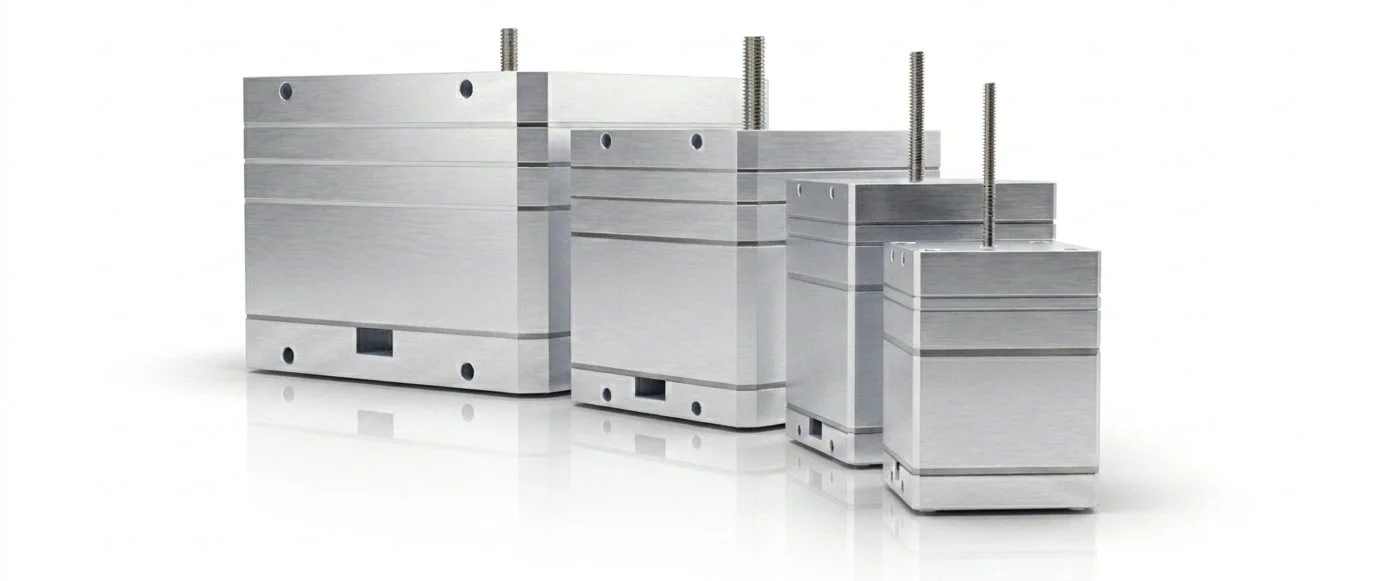
This unlocks the benefits of reluctance actuation for next-generation high-performance systems, including much improved efficiency, the highest force-density of all electromagnetic actuators, lower thermal drift, higher mechanical bandwidth, and extremely high dynamic performance, with accelerations in some applications exceeding 100 m/s².
Reluctance actuator technology is also highly scalable, with implementations ranging from milli-Newton to kilo-Newton force levels. Combined with its high force density and energy efficiency, this enables compact actuator solutions across a wide range of precision and industrial applications.
Fluxthor’s reluctance actuators can additionally integrate the mover and electromagnetic components into a single assembly, reducing the precise alignment challenges between coils and magnets often encountered in OEM voice coil actuator integration. Depending on the actuator design, reluctance actuator technology can also reduce dependence on rare-earth magnetic materials compared to conventional Lorentz-style actuators.
As precision systems increasingly become limited by thermal effects and force density constraints, reluctance actuators are emerging as a promising alternative to voice coil actuators and other Lorentz-style actuators, such as linear motors. Following early adoption of reluctance actuator technology by companies such as ASML, Fluxthor is the first company to offer commercially available reluctance actuators.
Less Heat, More Force

Below are three practical examples of how reluctance actuators can significantly improve the design and performance of systems that traditionally rely on voice coil actuators:
Fast Steering Mirrors (FSMs)
Fast steering mirrors require extremely high bandwidth, low settling times, and exceptional positional stability in applications such as laser beam steering, free-space optical communication and semiconductor inspection. In these applications, even small temperature changes can alter mirror geometry or introduce angular drift, reducing optical accuracy and long-term stability.
While voice coil actuators are commonly used in FSM systems because of their smooth force output and highly linear behaviour, the heat they generate can create problems in high-precision optical environments. In many VCA-based designs, the heat-generating coils must be placed farther away from the mirror or separated with larger magnetic assemblies to reduce heat transfer to the optics.
Although this helps protect the mirror from thermal distortion, it also increases system mass, footprint, and mechanical complexity, ultimately limiting bandwidth and overall performance.
Reluctance actuators dramatically reduce heat generation near the mirror, enabling more compact FSM architectures with higher resonance frequencies and improved pointing stability. Their compact magnetic design also reduces stray magnetic fields near sensitive optical and sensing components.
Application Examples
Active vibration isolation systems require actuators to continuously generate counterforces to suppress external disturbances. Because voice coil actuators require constant current to maintain force, they continuously dissipate heat, reducing efficiency and increasing cooling requirements in such systems.
Reluctance actuators are far more efficient in these applications because they can maintain high static forces with minimal heat generation and substantially lower continuous power consumption than VCAs. This improves long-term stability while reducing thermal drift, system complexity, and power consumption. It is therefore not uncommon for a single reluctance actuator to replace two or three similar-sized voice coil actuators in vibration isolation applications, lowering overall system costs.
Vibration Isolation Platforms
Nanopositioning systems operate at resolutions where even tiny thermal expansions can reduce positioning accuracy and repeatability. In voice coil-based stages, heat generation can introduce thermal drift that limits long-term stability and bandwidth.
Reluctance actuators minimize heat generation at the source, enabling improved thermal stability, higher dynamic performance, and more force-dense stage designs for semiconductor, photonics, and precision metrology applications.
Nano-Positioning Stages
Voice coil actuators have remained the dominant electromagnetic actuation technology in precision motion systems for decades because of their simplicity, controllability, and highly linear force behavior. However, as next-generation systems continue pushing toward higher throughput, smaller footprints, higher bandwidth, and more demanding thermal environments, the inherent scaling limitations of Lorentz-force actuation are becoming increasingly difficult to overcome.
By relying on nonlinear magnetic force generation rather than linear current-force scaling, reluctance actuators offer a fundamentally different approach. Their combination of high force density, low heat dissipation, compact integration, and high dynamic performance enables new possibilities for precision systems operating at the limits of speed, stability, and thermal control.
As industries such as semiconductor manufacturing, vibration isolation, advanced microscopy, and precision photonics continue to evolve, reluctance actuator technology is positioned to become an increasingly important alternative to conventional Lorentz-style actuators.
Conclusion
Contact Us
We will get in touch shortly to discuss possibilities and find a suitable solution for your application.