

Piezo actuators are widely used in precision motion systems because they offer exceptional positioning resolution, fast response times, and high force generation in compact form factors. However, the piezoelectric effect inherently produces only very small displacements, limiting the achievable stroke to microns or, with amplification mechanisms such as flexures, several hundred microns in long-stroke piezo actuators.
Extending the travel range in this way reduces stiffness and force output while adding complexity. Furthermore, piezo actuators typically require high voltages and rely on piezoceramic materials that can crack under mechanical stress. As a result, engineers often face a trade-off between travel range, speed and force.
Like piezo actuators, Fluxthor’s reluctance actuators offer highly dynamic motion with nanometer precision and high force output. However, by generating motion through controlled attractive force between ferromagnetic materials rather than piezoelectric deformation, they can achieve strokes of over a millimeter without mechanical amplification, overcoming one of the fundamental limitations of piezo actuator technology.
Compared to piezo actuators, Fluxthor reluctance actuators give larger physical dimensions, but offer:
Longer stroke lengths (>1 mm) without flexures
High, contactless force generation
(Sub-)nanometer positioning accuracy
No risk of ceramic cracking, leading to improved reliability
Low drive voltage (<75 V), downsized electronics
No creep and reduced hysteresis
Excellent vacuum and cryogenic usability
Scalable across force ranges from mN to kN
Overcoming Piezo Actuator Limitations with Reluctance Actuators
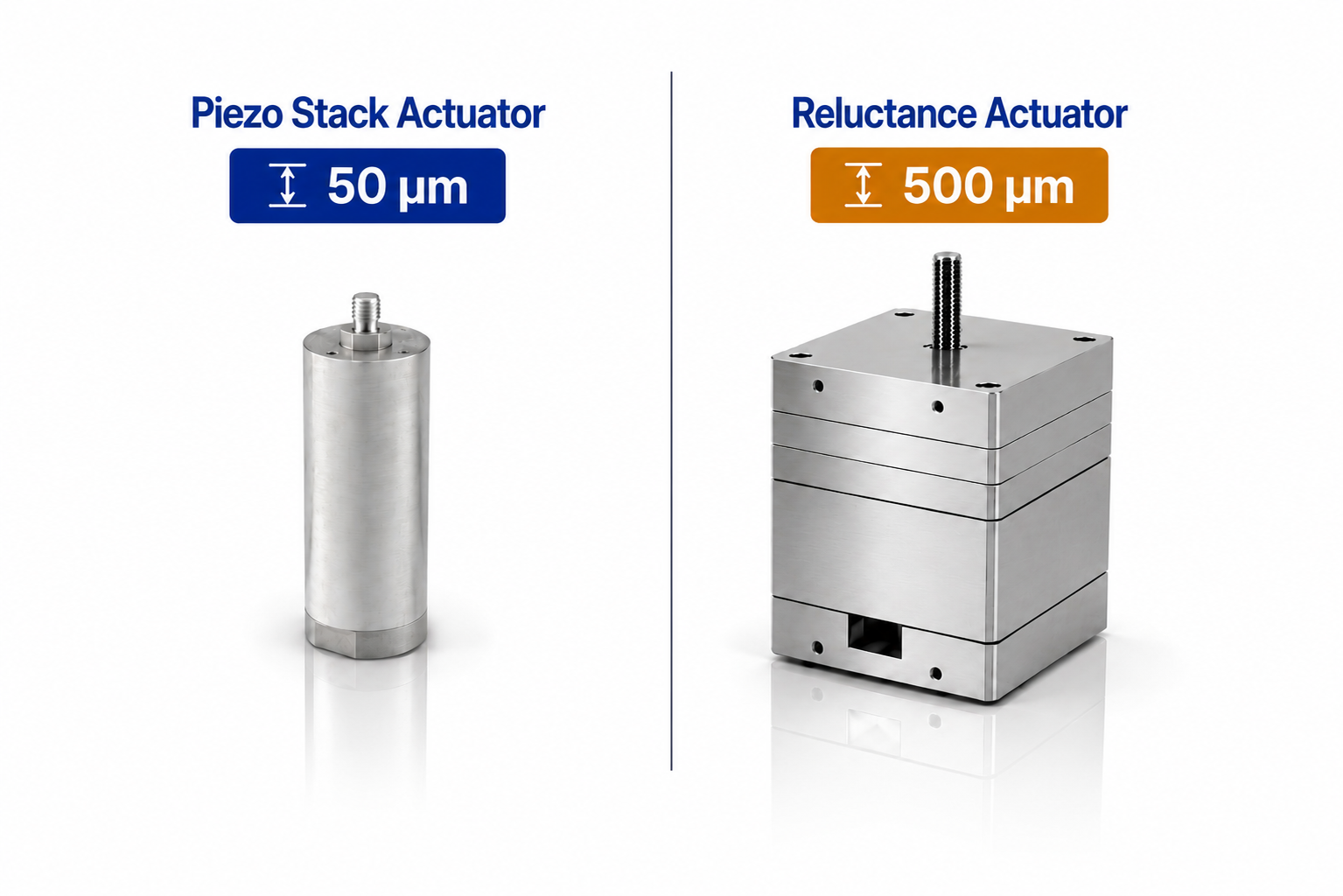
This makes reluctance actuators a strong alternative for piezo actuators in demanding applications such as semiconductor manufacturing, microscopy systems, vacuum setups and vibration isolation platforms.
Piezo Actuators in High-Precision Applications
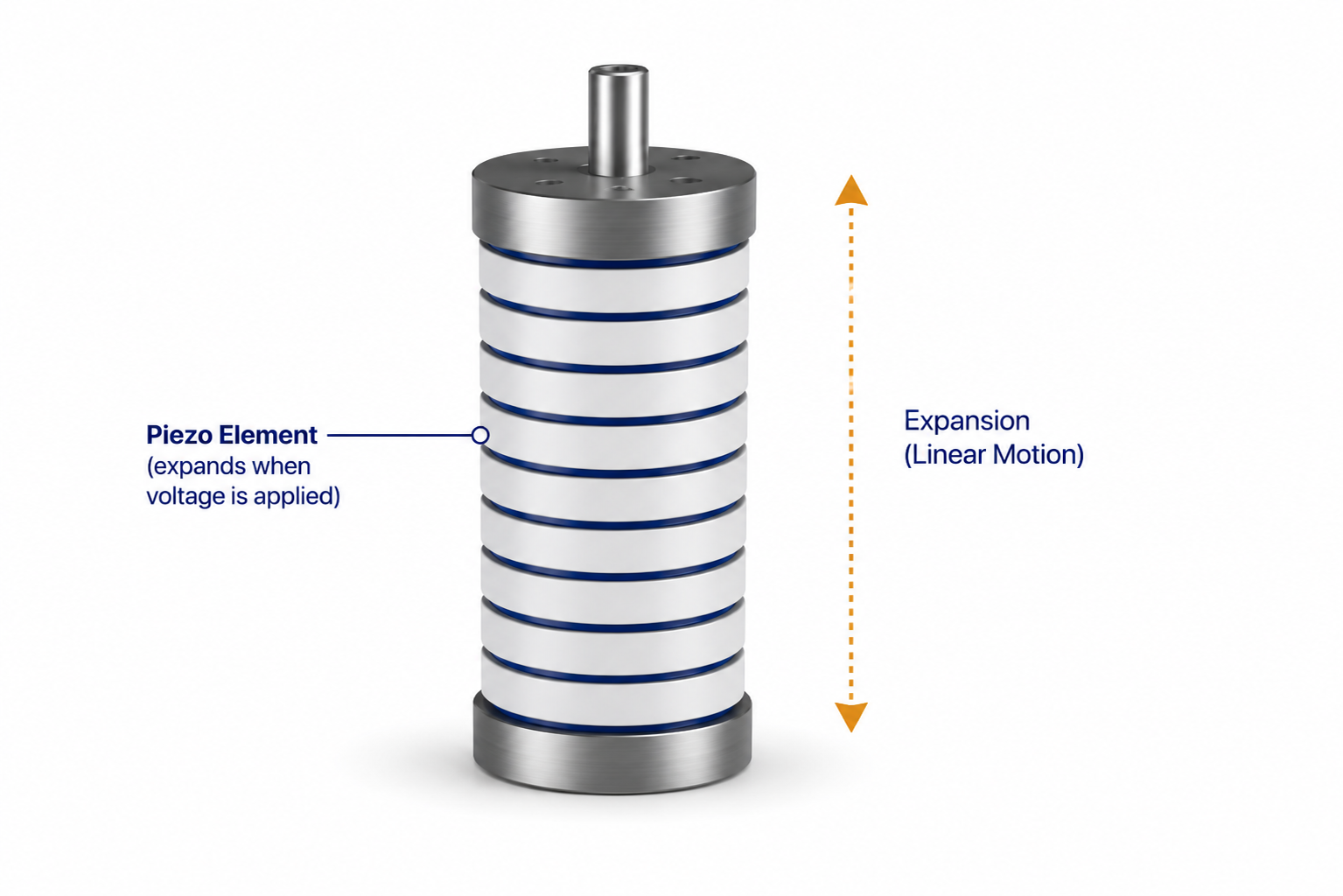
Piezo actuators are precision actuators that generate motion through the piezoelectric effect, where an applied voltage causes a piezoelectric ceramic element to expand or contract. This enables exceptionally fast response times, high force generation, nanometer-scale positioning resolution, and direct-drive motion without mechanical transmission components. Various different types exist, with piezo stacks being the most common and fundamental design.
Due to their excellent positioning accuracy, high stiffness, compact size, and favorable high-frequency response, piezo stacks have become an established actuation technology in many high-performance precision motion systems.
They have been widely used for decades alongside voice coil actuators in applications such as semiconductor manufacturing, fast steering mirrors, microscopes, vacuum setups and vibration isolation platforms.
Strong and Precise
However, the piezoelectric operating principle inherently produces only very small strains. As a result, piezo stack actuator displacement is typically limited to a few microns or, in some cases, a several hundred microns when mechanical amplification mechanisms are used.
This limited stroke is a big constraint for many engineers, as the advantages of piezo actuators (precision, responsiveness, and force) would otherwise make them highly desirable for a broader range of cutting-edge applications and boost performance in existing ones.
As such, engineers look for ways to overcome this limitation, but their options are scarce, and often present hard choices.
Stroke Length: The Biggest Limitation of Piezo Actuators
Increasing Stroke Length in Piezo Actuators
Amplified Piezo Actuators
To achieve larger travel ranges, engineers and piezo actuator manufacturers often rely on displacement amplifiers such as flexures. Such high-displacement piezo actuators are often called amplified piezo stacks, integrated piezo actuators or piezo flexure actuators.
While effective - amplification can increase stroke from several microns to a few hundred microns - this solution significantly reduces the available output force, limiting this technique to only a specific set of applications.
To put this force reduction into perspective, a ‘pure’ piezo stack can typically deliver several thousands newtons of force, whereas an amplified piezo actuator, which uses a flexure mechanism to increase stroke, is generally limited to just a few newtons. In other words, gaining stroke comes at the cost of one of the piezo actuator's greatest strengths: force.
In addition, using flexures inherently reduces system stiffness, sacrificing yet another key benefit of piezo stacks, which are themselves extremely stiff. This reduced stiffness further limits the mechanical bandwidth and therefore the responsiveness of the overall motion system.
Some engineers turn to longer-stroke alternatives such as voice coil actuators, but this means sacrificing a lot of force output and energy efficiency for displacement, which we have covered in detail in this article.
The Displacement Dilemma
An additional option for achieving larger stroke lengths while retaining the benefits of piezo stacks is simply to use larger and longer stacks. However, the resulting increase in electrical capacitance reduces the achievable bandwidth for a given amplifier. Maintaining high bandwidth therefore requires larger, higher-current drive electronics, increasing system size, complexity, and cost. This becomes especially challenging in multi-axis systems or applications with hundreds of actuators, such as deformable mirrors.
The resulting trade-offs become increasingly significant as performance requirements continue to grow. Engineers are frequently forced to choose between travel range and force, or between simplicity and performance.
In addition, the brittle nature of piezoelectric ceramics raises concerns regarding shock resistance, overload conditions, and long-term reliability in industrial environments as the technology is pushed closer to its limits. This is especially relevant in applications such as space instruments and EUV lithography systems, where actuator replacement is either impossible or requires extensive downtime.
As the demands of next-generation technologies continue to increase, these limitations are revealing the practical boundaries of conventional piezo actuator technology, particularly in applications requiring not only high-force, nanometer-accurate positioning, but also larger stroke lengths.

Vacuum and cryogenic environments are becoming increasingly important in applications such as quantum computing, semiconductor metrology, electron microscopy, space instrumentation, and advanced scientific research. These environments enable higher precision and stability by reducing contamination, heat, and environmental disturbances, but they also place unique demands on motion systems.
Piezo actuators are widely used in these environments due to their vacuum compatibility and ability to operate with nanometer precision at cryogenic temperatures. However, the displacement of piezoelectric materials decreases significantly at cryogenic temperatures, often reducing the available stroke of cryogenic piezo actuators to only 10–30% of its room-temperature value, further limiting the achievable travel range.
Perhaps even more importantly, many cryogenic applications require a force or position to be maintained for extended periods without introducing heat into the system. While piezo actuators like piezo stacks consume very little power in static operation, they require a maintained electric field to sustain displacement and lose their position when power is removed. This can create challenges in applications where zero-heat holding force, long-term stability, or fail-safe position retention are required.
Vacuum environments also introduce additional challenges. Piezo actuators typically require operating voltages in the range of 100–200+ V, increasing the complexity of electrical integration through stricter insulation, wiring, and feedthrough requirements.
As cryogenic and vacuum systems continue to grow in complexity and performance requirements increase, these limitations become increasingly significant.
Piezo Actuator Limitations in Vacuum and Cryogenic Environments
Reliability Considerations for Piezo Actuators
Piezo stack actuators are constructed from brittle ceramic materials, making them susceptible to cracking under excessive mechanical stress, shock, vibration, or improper mounting conditions. Even minor cracks can degrade performance, while severe damage may lead to complete actuator failure.
To prevent damage, piezo stacks typically require careful mechanical integration, especially when working at nanometer scale. Tensile loads, side loads, and misalignment must be minimized, often requiring preloading mechanisms and additional design considerations to ensure reliable operation over time.
Finally, piezoelectric materials can experience gradual performance degradation due to aging, repeated cycling, or exposure to elevated temperatures and electric fields. These effects can reduce stroke, force output, and positioning performance over the lifetime of the actuator.
Reluctance Actuators: A Long-Stroke Alternative to Piezo Actuators
Reluctance Technology
Like piezo actuators, reluctance actuators are capable of achieving (sub)nanometer positioning precision and highly dynamic performance. However, rather than relying on the deformation of piezoelectric ceramics, reluctance actuators generate motion through electromagnetic forces created by changes in magnetic reluctance. This enables force generation across an air gap without requiring direct mechanical deformation of brittle active materials.
Unlike piezo actuators, whose travel range is fundamentally limited by the strain of piezoelectric materials, reluctance actuators can achieve travel ranges orders of magnitude larger without mechanical amplification. This enables a unique combination of millimeter-scale stroke, high precision, high force output, and excellent dynamic performance.
Despite these advantages, reluctance actuators have historically seen limited adoption in high-precision positioning systems. Their nonlinear magnetic behavior and complex control dynamics made it difficult to achieve the positioning stability and control accuracy demanded by semiconductor equipment, optical systems, scientific instrumentation, and other advanced motion applications.
Fluxthor has overcome these challenges through advanced actuator architectures and control methods that enable reluctance actuators to achieve stable, highly precise, and dynamic motion control while retaining the inherent benefits of reluctance actuation.
Long Stroke Without the Trade-Offs
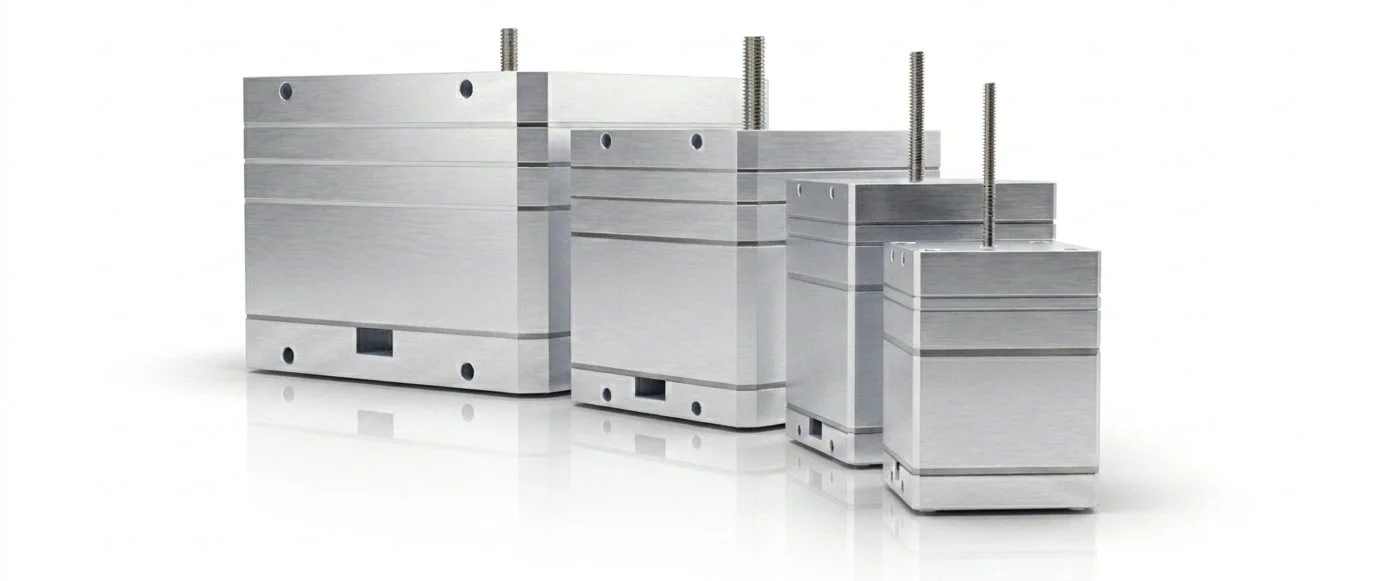
This unlocks a unique combination of capabilities that are difficult to achieve with conventional piezo stacks or amplified piezo actuators. Reluctance actuators can provide substantially longer travel ranges while maintaining high positioning precision, high force output, and excellent dynamic performance.
The technology also offers advantages in demanding vacuum and cryogenic environments. Because reluctance actuators rely on electromagnetic rather than piezoelectric actuation, they avoid the fundamental reduction in displacement experienced by piezoelectric materials at cryogenic temperatures. In addition, reluctance actuators can be designed for very low heat dissipation, down to just a few milliwatts, helping to minimize thermal loads in cryogenic systems. Lastly, their lower operating voltages further simplify electrical integration in vacuum environments.
Reliability can also be improved by eliminating one of the most common failure mechanisms associated with piezo stack actuators: ceramic cracking. Because reluctance actuators do not rely on the deformation of piezoelectric ceramics to generate motion, they are inherently immune to this failure mode, improving robustness and longevity in demanding industrial and scientific applications.
As next-generation systems increasingly demand both nanometer-level precision and millimeter-scale travel ranges, reluctance actuators are emerging as a compelling alternative to piezo actuators. Following early adoption of reluctance actuator technology by companies such as ASML and TNO, Fluxthor is the first company to offer commercially available reluctance actuators.
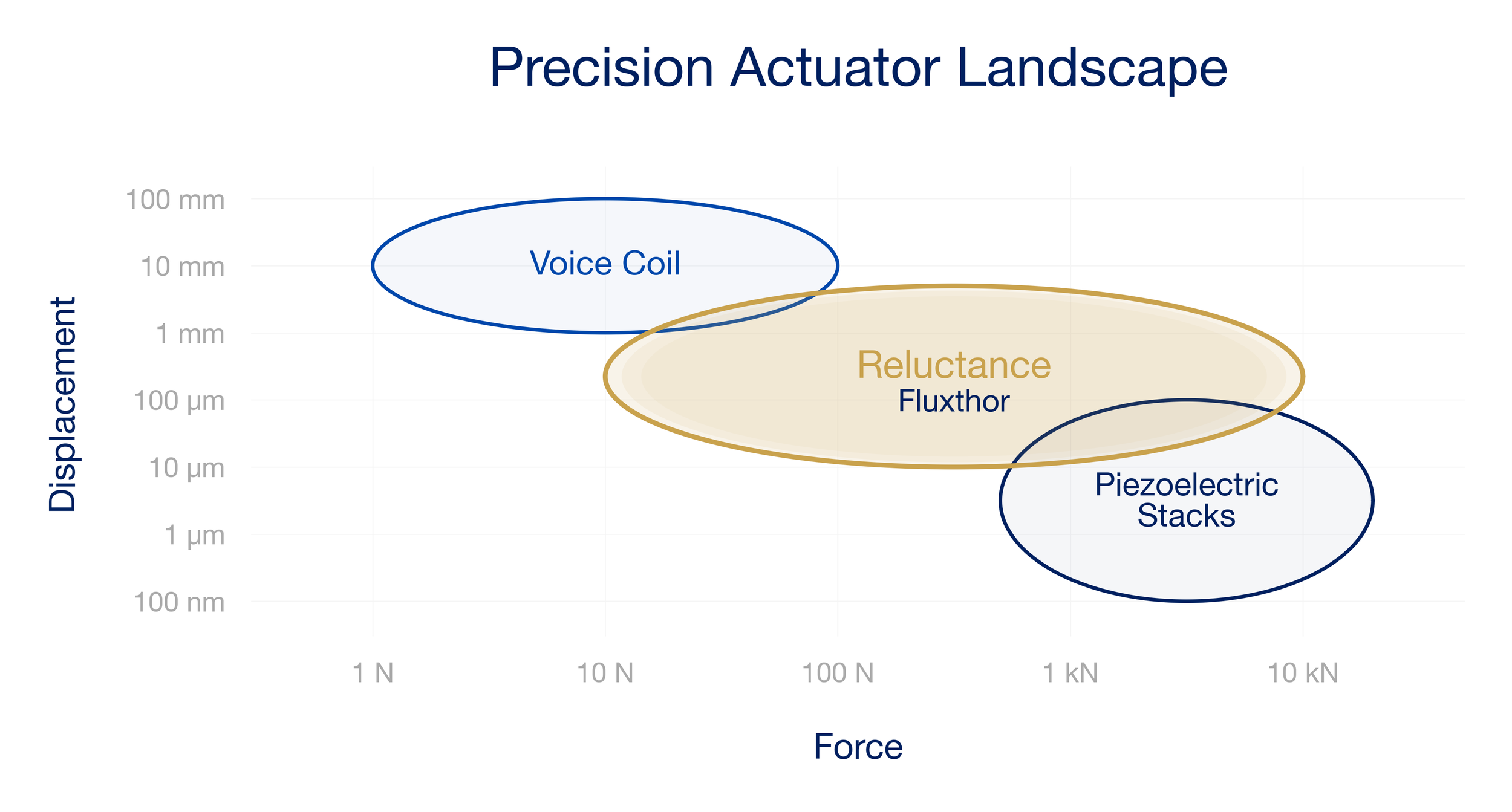
Below are three practical examples of how reluctance actuators can significantly improve the design and performance of systems that traditionally rely on piezo actuators such as piezo stacks or piezo flexure actuators:
Vibration Isolation Platforms
Active vibration isolation systems require actuators capable of generating precise counterforces at high bandwidth to suppress external disturbances. Piezo actuators are widely used in these systems due to their exceptional responsiveness, high force output, and nanometer-level positioning precision. However, their inherently limited stroke can restrict the range of disturbances that can be compensated. When larger compensation amplitudes are required, engineers typically need to either incorporate displacement amplification mechanisms or switch to alternative actuator technologies such as voice coil actuators.
Piezo actuators also require a mechanical connection between the actuator and the payload. This coupling can transmit unwanted vibrations and mechanical disturbances to the very payload the system is intended to isolate. Reluctance actuators, by contrast, can generate force across an air gap, enabling contactless actuation and eliminating this direct mechanical coupling.
Reluctance actuators offer a strong alternative by combining highly dynamic performance with travel ranges that are orders of magnitude larger than those of piezo stacks. This enables larger disturbance compensation without mechanical amplification, while maintaining high force output and positioning precision. Their contactless force transmission can also help prevent unwanted vibration transfer to the payload. As a result, reluctance actuators can simplify system architectures, reduce performance trade-offs, and expand the operating range of active vibration isolation platforms.
Fast Steering Mirrors (FSMs)
Fast steering mirrors are critical motion components in demanding optical systems, from Pointing, Acquisition and Tracking (PAT) systems for free-space optical communication to beam positioning and stabilization systems in semiconductor inspection and lithography. Across these applications, extremely high bandwidth, low settling times, and exceptional stability are essential. Piezo stack actuators are widely used in these systems because of their high stiffness, fast response, and ability to achieve extremely small angular motions with exceptional precision.
However, the limited displacement of piezoelectric materials restricts the achievable angular range, particularly in larger-aperture mirrors or applications requiring larger beam steering angles. Achieving greater angular travel often requires amplified piezo mechanisms or more complex mirror architectures, introducing additional complexity and trade-offs in stiffness and responsiveness. Lorentz-style actuators such as voice coils are also common in free-space optical communication due to their larger travel range, but present challenges in thermal management and force density.
Reluctance actuators offer an attractive alternative by combining dynamic performance with substantially larger stroke capability than (amplified) piezo stacks, effectively setting the performance frontier for bandwidth and angular range in FSM actuators. This allows for fast steering mirror systems to achieve larger angular ranges at a given bandwidth, or higher bandwidth at a given angular range, while maintaining high pointing precision and low heat dissipation.
Nano-Positioning Stages
Nanopositioning stages based on reluctance actuators offer substantially longer travel than conventional piezo stages without flexure amplification. They combine nanometer-level precision with high force output and large stroke capability, reducing the need for separate coarse-positioning mechanisms.
Their excellent vacuum and cryogenic compatibility also makes them a promising alternative to piezo-based stages in quantum research, space systems, semiconductor equipment and advanced scientific instrumentation.
Application Examples
Conclusion
Piezo actuators have remained a cornerstone of precision motion systems for decades due to their exceptional positioning resolution, fast response times, and high force generation. However, as next-generation systems increasingly demand both nanometer-level precision and millimeter-scale travel ranges, the inherent stroke limitations of piezoelectric actuation are becoming increasingly difficult to overcome.
By generating motion through controlled magnetic reluctance forces rather than the deformation of piezoelectric materials, reluctance actuators offer a fundamentally different approach. Their combination of long stroke, high precision, high force output, zero-heat static force generation, and compatibility with vacuum and cryogenic environments enables new possibilities for precision positioning systems.
As industries such as semiconductor manufacturing, quantum technologies, advanced microscopy, photonics, and scientific instrumentation continue to evolve, reluctance actuator technology is establishing itself as both a powerful alternative to conventional piezoelectric actuators and a key enabling technology for the next generation of precision motion systems.
Contact Us
We will get in touch shortly to discuss possibilities and find a suitable solution for your application.