

What are Reluctance Actuators?
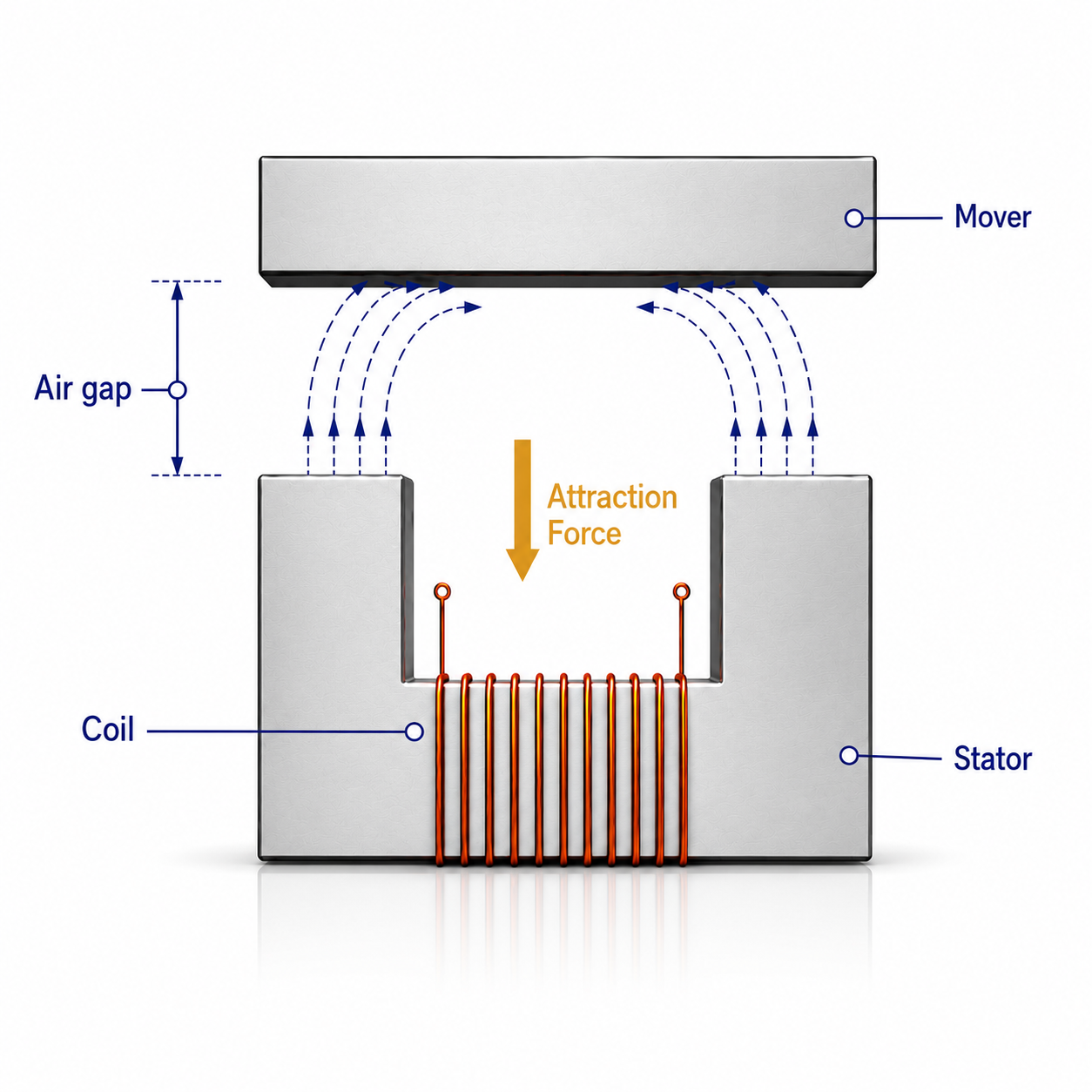
Reluctance actuators generate force by pulling ferromagnetic materials toward electromagnets, no permanent magnets needed. When current flows through coils, the magnetic circuit creates an attractive force that pulls a ferromagnetic mover towards the stator. The principle is elegantly simple and offers compelling advantages: extreme force density and exceptional energy efficiency.
Unlike voice coil or Lorentz actuators that rely on permanent magnets and moving coils, reluctance architectures concentrate magnetic flux in the air gap, producing significantly higher force per unit volume. Compared with piezo actuators, which typically provide only tens of micrometers of stroke, reluctance actuators can achieve up to over a millimeter without using amplification, while maintaining high force and a compact form factor.
This makes them ideal for applications demanding high force and greater stroke in compact spaces, from semiconductor wafer stages to precision optical systems and vibration isolation platforms.
The physics of reluctance has been understood for many decades. Yet despite clear performance advantages, reluctance actuators remained confined to niche applications. The reason? A fundamental control challenge that made them impractical for precision motion systems.
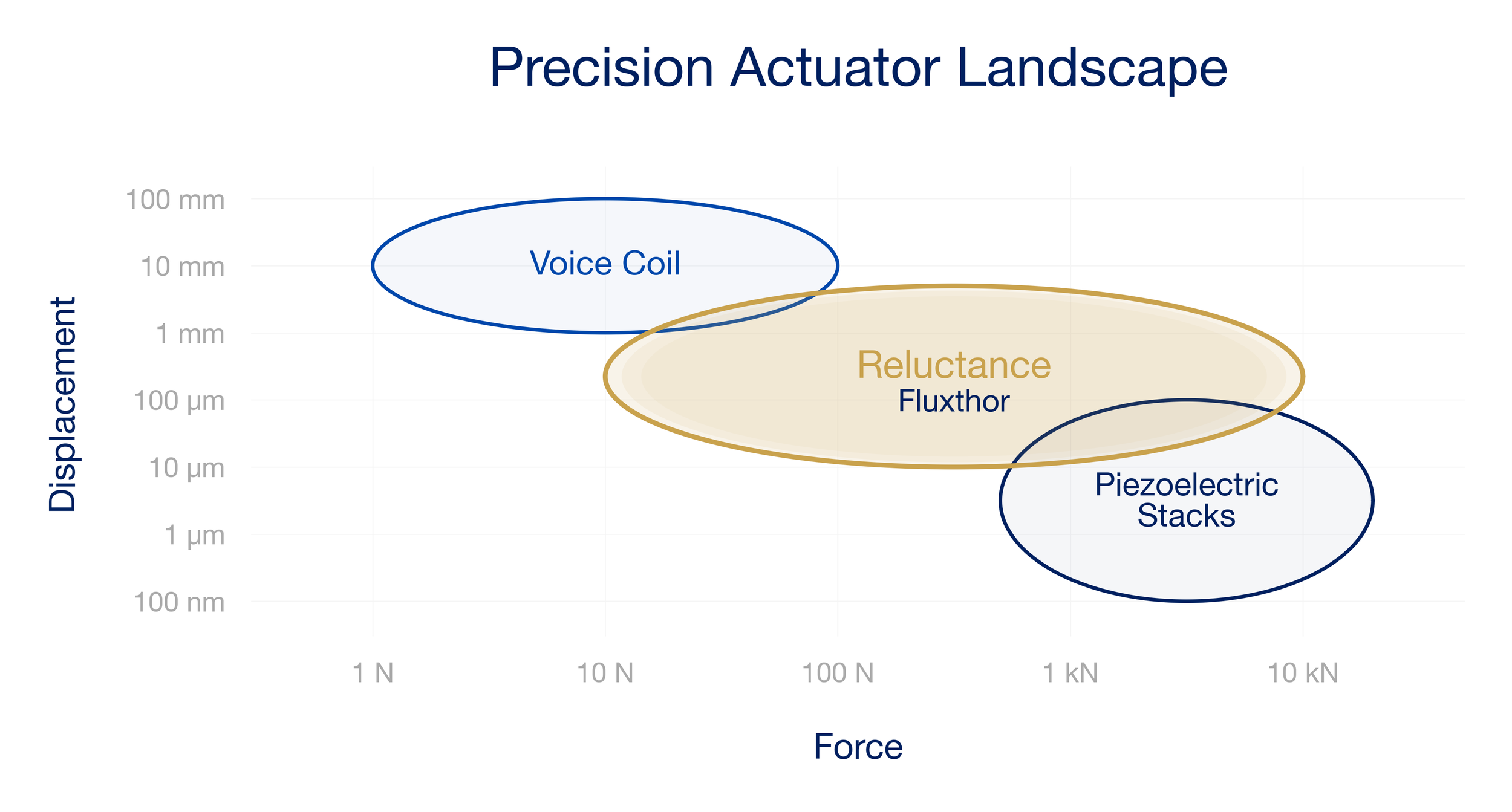
Reluctance actuators bridge the gap between conventional electromagnetic actuators and piezoelectric actuators, offering (sub-)nanometer precision and high bandwidth, without compromising thermal management, force density, or stroke length
What made reluctance actuators so hard to control?
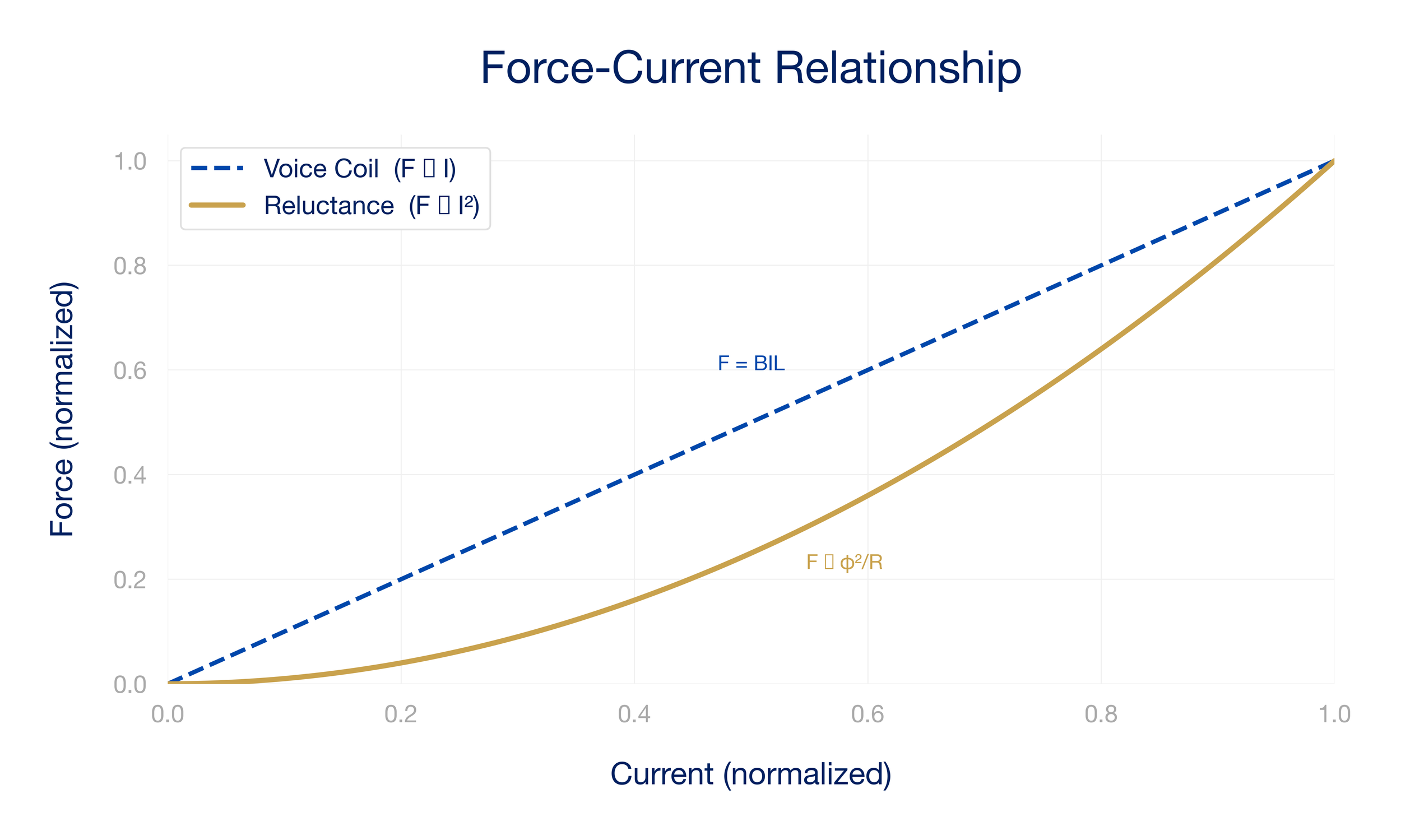
The challenge with traditional reluctance actuators lies in their inherent nonlinearity. Reluctance force is inversely proportional to the length of the air gap, meaning force increases exponentially as the actuator reaches its maximum stroke. This creates a "pull-in" instability: as the armature approaches the electromagnet, attractive force grows rapidly, making precise position control extremely difficult.
This nonlinearity has prevented reluctance from competing with linear actuators like voice coils in precision applications. Engineers attempting to use reluctance faced:
Complex control algorithms requiring extensive system modeling and parameter tuning
Position-dependent dynamics that changed dramatically across the stroke range
Instability at high precision where small position errors cascaded into oscillations
Long integration cycles demanding custom firmware for each application
The result: reluctance actuators remained relegated to simple on/off applications (solenoids, contactors) or highly specialized systems with dedicated control engineering resources. OEMs designing semiconductor equipment, optical systems, and precision instruments couldn't justify the integration cost and risk, even when reluctance offered superior performance on paper. However, that has been changing up until recently in the last few years.
How Fluxthor solves the complexity of Reluctance Actuators
The challenge
The industry's default response to reluctance nonlinearity has been computational brute force: real-time flux estimation, adaptive control algorithms, and high-bandwidth current loops. This works but at a cost. Complex control demands expensive electronics, specialized engineering expertise, and extensive tuning for each application. The actuator becomes hostage to its controller, adding layers of overhead that complicate the system architecture.
The Invention of Reluctance Tuning
By utilizing a patented coil-free architecture, we eliminate the primary source of thermal instability, Joule heating. While traditional actuators struggle with energy losses, our design maintains static high-force with zero heat dissipation. This thermal stability is critical for accuracy; by removing the thermal gradient, we allow the actuator to go beyond nanometer precision, as there is no heat-induced structural expansion to compromise the position.
How we engineered the solution
The result is an actuator that delivers high force density, smooth motion, and predictable hysteresis, all while remaining controllable with our in-house developed servo drives. We solved the thermal and nonlinear challenges at the physics level, by using holistic loss models, flux observers and nonlinear algorithms. This delivers plug-and-play precision, unlocking the massive benefits of reluctance performance for high-speed and high-precision markets, delivered at scale for everyone to integrate.
Patent protection
This invention is protected by two patent filings covering the coil-free magnetic circuit and the reluctance tuning methodology. These patents secure Fluxthor's proprietary position in quasi-static zero heat dissipation actuation, specifically focusing on how we switch and adjust magnetic resistance to generate force without the energy losses associated with traditional electromagnetic coils.
The Benefits of Reluctance Actuators

Extreme Force Density
- 5x Higher force density than voice coils
- Drastically reduce system footprint

Energy Efficiency
- No energy loss at quasi-static forces
- Motor constant: up to 500 N/A
High Servo Bandwidth
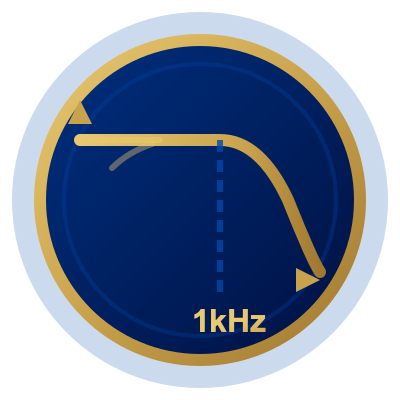
- Mechanical resonance of >1kHz
- Faster response, higher throughput

Reliability & Longevity

Scalability across Sizes

Independent of Rare Earth Metals
Contact Us
We will get in touch shortly to discuss possibilities and find a suitable solution for your application.